



The following remarks were shared by longtime CRS congregant Cindy Spiegel during our Yom Kippur Yizkor service in memory of her parents, Aaron and Helen Spiegel.
“In 2013, my friend Kirsty invited me to join her on a trip to Germany to attend a three-day darshan with the Indian spiritual “avatar” Mother Meera. Rachel, our daughter, then eighteen, decided to join me, and we planned to meet up afterward with my husband, Peter, and our son, Jonathan, at a friend’s apartment in Paris, for a family vacation.
During darshan, each person in the room kneels before Mother Meera while she places her hands on your head, and when she removes them, you look up into her eyes until she turns her head away. It all made me uncomfortable—the kneeling before someone; the awkwardness of staring into a person’s eyes.
Rachel and I were sharing a bed in our hotel, and on the second night after darshan my deep sleep was disturbed by a bright light shining in my eyes. I tried to rouse myself enough to tell Rachel to turn off her phone—but then she poked me and woke me. She told me I’d been snoring. There was no light. I’d been keeping her up.
In the morning, I told Kirsty what had happened. “But that’s what Mother does,” she said. “She gives people light.”
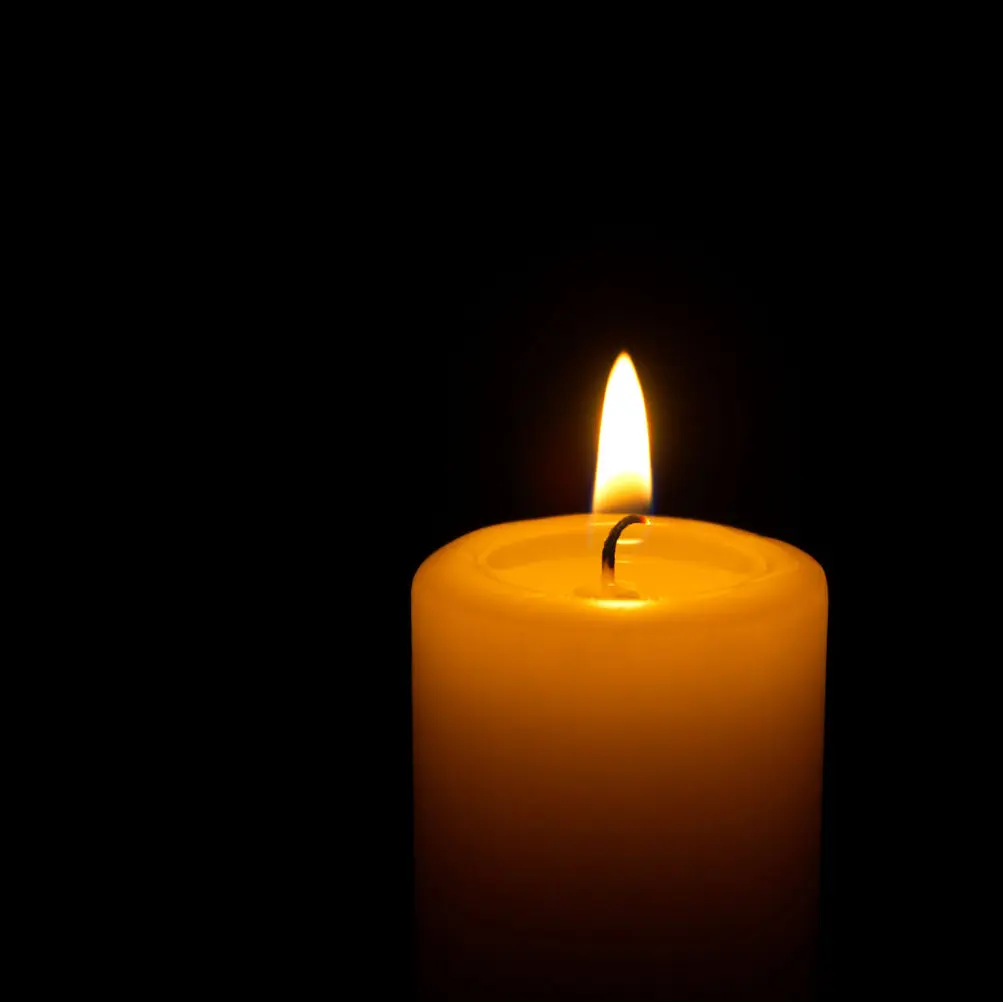
In Paris, in the tiny, dimly lit WC in our friend’s apartment, just a toilet, small sink, and a big mirror facing me, I sat looking into my own reflection, which made me think about the experience of two eyes staring into two eyes. I fell into a meditative state, and at some point, I glimpsed what seemed to be a warm yellow ball of light glowing around my core. Was it real? I didn’t break my stare to find out. But as I continued to gaze into my reflection, the ball seemed to grow, its light filling the room. I shook myself from my daze and looked up. The formerly dull lightbulb was now brilliantly bright. It was one of the strangest and most mystical experiences I’ve ever had.
The next morning, my sister called. “Daddy’s in the hospital, dying,” Shari said. “You need to come home.” The doctors had given him only hours to live.
Some of you knew my father, Aaron Spiegel. He was a trustee here at Rodeph and an active member of the community. He had been diagnosed with stage four lung cancer eight years earlier, just before his eightieth birthday, and yet he had exceeded his doctor’s expectations, and we’d begun to think he’d be with us forever.
Amazingly, my father was still alive when we rushed to the hospital from the airport. I had taken the week off from work, so while Shari was crazed, running to the hospital between preparing for a big presentation at the UN and being home for her young son, I was simply there, with my father. I told him the story of the lightbulb, showed him a photograph of Mother Meera—and when we were alone together, he would look into her eyes, as I’d instructed. As my father faced the end, I hoped he too would experience Mother Meera’s light, the divine spiritual energy she says she imparts to us.
Soon my father’s hospital room was filled with people who had come to say goodbye. We sang; we talked; we laughed a lot, my father joking with his nurse through his oxygen mask. Then my mother, who was suffering from dementia, fell and ended up in the hospital a floor above him. We wheeled her down to his room and she sang to him—“It Had to Be You.” “I’ve seen a lot of people die in my life,” my mother said, “but never like this.”
I started sleeping in my father’s hospital room. On the second night, I woke up at 3 am to my father coughing, having trouble breathing. I yelled for the nurses—and they fumbled and dropped their instruments as they tried to aspirate him—and then went to fetch new sterilized instruments as I watched my father choke to death, his eyes looking in to mine, wide in fear.
Shari said, “I’m glad it was you, not me. I couldn’t have handled it.”
The nurse my father had been joking with said, “You were the lucky one.”
And I did feel lucky, though I will always carry the terrible image of my father’s eyes filled with fear. And yet that very same painful scene is also a comfort to me—because I was with him when he died. He wasn’t alone.
I decided to perform shloshim for my father—he had grown up in an Orthodox family, and I had a memory of him going out every morning to say kaddish after my grandfather died. I thought it was something that would be meaningful to him. I didn’t realize how meaningful it would end up being for me.
Saying kaddish for thirty days, before Zoom, wasn’t easy. I had to figure out where to go, and I had to go to places where I wasn’t comfortable—Orthodox shuls where the women were cordoned off; where I didn’t know how to follow the siddur. And yet magical things happened. At a shabbat service on the beach, dolphins leaped in the ocean; it turned out to be a children’s service and there was no kaddish, but the rabbi called out on his megaphone for ten Jews to gather for kaddish—and people showed up, asking shyly if I minded that they were in their bathing suits. At another service, Neshama Carlbach, the daughter of Shlomo Carlbach, sang, and I was reminded of how my father would take Shari and me to the Carlbach shul on 79th Street for Simchat Torah—afterward I thanked Neshama for giving back to me a memory of my father, and we cried together at the memories of both our fathers. And on the last day of shloshim, at the Jewish Center on 86th Street, I accidentally knocked over the mechitza in the middle of the service and it came crashing down. I was mortified, but the rabbi came over and introduced himself, saying, “now we’ve had the chance to meet.”
I carried my father with me during those days. I spoke to him and felt him close. At the shiva, people told remarkable stories. One man who’d grown up in a building my father managed told us that when he was a boy, he’d been a difficult child—his father had died, and he and his brother were hoodlums, he said. But my father would pay him to do odd jobs in the building, and when he was older, my father would hire him to step in when the super was on vacation. He’s now a high-end contractor. “Your father changed my life,” he said.
So even after my father’s death, I continued to get to know him, sometimes in ways I never knew him in life.
Three years later, in 2016, when my mother died, I was with her too. That morning, we were sitting by her bed when my phone rang. I stepped into the hallway to take the work call, and as I spoke, I watched my mother’s aide close my mother’s eyes. Had I missed being with my mother at the moment of her death? I got off the call, and we searched for a pulse, a heartbeat. I leaned over and held her in my arms, hugged her to me—and suddenly we all heard it: a deep intake of breath. A big sigh out.
A few weeks later I was listening to an NPR program about the various ways different cultures identify the moment of death. In some traditions, it’s when the heart stops; in others, when the brain shuts down or the soul leaves the body. In Judaism, at least according to NPR, it’s the last breath.
All of us will experience the deaths of our loved ones in different ways. Some will be unexpected, untimely, tragic. Some, like my parents’, will be part of a more natural order. It’s never easy—but I don’t think easiness is the point. My parents’ deaths are among the most meaningful experiences of my life.
I’m a book editor, and soon after my mother’s death, I received a book proposal from a Jewish clairvoyant, Marilyn Kapp. She offered me a session, which was extraordinary—when my parents spoke to me through her, their voices rang true. She said, “You know how in those final years, when your mother had no short-term memory and had to rely on other people for everything, how she would have hated being like that? Well, your mother spent her whole life running around doing things for other people. She never sat still, and she never let anyone help her. But in the end, she had to allow people to help. She had to sit still. Those years were necessary for her soul’s development. She had to learn to just be.”
When Marilyn said that my mother’s most terrible years were actually part of her growth, she reframed my understanding of that painful time in a much more meaningful and bearable way.
Rachel and her husband now live in the apartment I grew up in; my 2-month-old grandson, Rafi, is growing up in my old bedroom. I wish my parents were here to meet him. But I don’t want my mother back as she was at the end—lying there staring into space. Or my father, sitting in his La-Z Boy chair, in pain but never complaining. I want them here vibrant and healthy—so I’d have to turn back my own clock too, and who wants to do that? Because living through their deaths changed me. Helped me grow. I came to see how their lives reverberated in the world—far beyond my comprehension—just as our lives affect others in ways we will never know. I can’t explain to you what happened with the light bulb—years later, when I told Mother Meera the story, she smiled, shrugged, and said, “sometimes things happen!”—but I know it shifted something in me, grounded me, and allowed me to be fully present in a new way.
When we reflect on our lives, we mostly think of the movement, the drama, the story. And who doesn’t love a great story? But I also remember what Marilyn told me: that my mother needed to learn to be still. Being here together for yizkor, which is itself a moment out of time, I think of those other powerful moments of stillness: sitting in darshan, meditating; looking into Mother Meera’s eyes and then my own; being with my father in the hospital; sitting beside my mother as she died.
Standing here, in this space I have been coming to for over 60 years—I feel my parents with me. And I also feel the presence of others who are no longer with us, who also helped shape me. I think of Rabbi Louis I. Newman, who inscribed a collection of his poems for me when I was a child; Rabbi Hirschberg, Cantor Biran, the friends of my parents I always counted on seeing at the holidays. They are all here with us, along with your loved ones. And we are all here too. Sitting together, we can perhaps feel ourselves as part of a larger whole, a community that expands beyond time. The light that Mother Meera shared with me—I believe it’s available to all of us. We just have to sit still to experience it.”